

Quick Answer: Hospital Floor Cleaning Equipment
Hospitals use microfiber flat mops in patient rooms and automatic floor scrubbers for large hard-floor areas like corridors, lobbies and cafeterias.
- Walk-behind scrubbers: patient wings, exam rooms, tighter corridors
- Ride-on scrubbers: main corridors, lobbies, cafeterias, atriums, parking decks
- Scrubber-sweepers: entrances, loading docks, service corridors, mixed debris
- Infection control: consistent soil and moisture removal, controlled chemical dosing, fast drying
- Rental: delivery, setup and operator guidance, short and long term
- Coverage: healthcare facilities across the Southeast US
Hospital floor cleaning equipment has to keep large, high-traffic floors clean, dry and safe around the clock. Thompson Flooring Solutions supplies and rents commercial floor scrubbers and sweepers built for healthcare facilities, from compact walk-behind machines for patient wings to ride-on scrubbers for long corridors, lobbies and cafeterias. Each machine is chosen to fit your facility’s layout, square footage and infection-control standards.
What Do Hospitals Use to Clean Floors?
Hospitals clean floors with a mix of methods. Patient rooms and tight spaces are cleaned with microfiber flat mops and hospital-grade disinfectant, while large hard-floor areas like corridors, lobbies, cafeterias and parking decks are cleaned far more efficiently with automatic floor scrubbers. Thompson Flooring Solutions supplies and rents walk-behind scrubbers, ride-on scrubbers and scrubber-sweeper machines built for the cleanliness, fast drying and quiet operation healthcare facilities need.
What Makes Our Floor Cleaning Equipment Work for Hospitals?
Our experience with healthcare facilities allows us to recommend solutions that align with strict cleaning protocols and safety standards. We provide commercial floor cleaning equipment that prioritizes both hygiene and staff efficiency.
- Equipment designed for consistent, high-level cleaning
- Quiet and safe options for corridors and patient areas
- Machines that support staff productivity and reduce manual labor
- Local service and support to ensure maximum uptime
Hospital Floor Cleaning Machines: Walk-Behind, Ride-On and Scrubber-Sweeper
Hospitals run on three types of automatic floor cleaning machines, chosen by the size and layout of the space. Walk-behind scrubbers handle patient wings, exam rooms, and tighter corridors where operators need to move around beds, carts, and equipment. Ride-on scrubbers cover the large open areas, main corridors, lobbies, cafeterias, atriums, and parking decks, where speed and square footage matter more than tight turns. Sweeper-Scrubbers combine sweeping and scrubbing in one pass, which suits entrances, loading docks, and service corridors where grit and debris get tracked in from outside.
| Machine type | Best hospital areas | Why it fits |
|---|---|---|
| Walk-behind scrubber | Patient wings, exam rooms, smaller corridors, restrooms | Compact and maneuverable around beds and equipment, quiet, fast drying reduces slip risk |
| Ride-on scrubber | Long main corridors, lobbies, cafeterias, atriums, parking decks | Covers large square footage quickly, less operator fatigue, consistent results across big areas |
| Sweeper-Scrubber | Entrances, loading docks, service corridors, mixed-debris areas | Sweeps debris and scrubs in one pass, handles grit tracked in from outside |
Most facilities use more than one. A single campus often pairs a ride-on scrubber for the main thoroughfares with a walk-behind for clinical spaces, plus a scrubber-sweeper near the docks.
Mopping vs Scrubbing for Large Hospital Floors
Mops still have a place in a hospital. For patient rooms, isolation areas, and spot cleaning, microfiber flat mops paired with hospital-grade disinfectant are the standard, because they trap soil, hold cleaning solution, and are easy to swap between rooms to limit cross-contamination.
The problem is scale. Once you move to long corridors, lobbies, and cafeterias, mopping spreads dirty water as much as it removes it, leaves floors wet long enough to become a slip risk, and takes far more labor to cover the same ground. An automatic floor scrubber lays down clean solution, scrubs, and recovers the dirty water in a single pass, so the floor is cleaner and nearly dry behind the machine. For large hard-floor areas, scrubbing is faster, more consistent, and safer than mopping.
The practical answer for most hospitals is both: microfiber mops for clinical and tight spaces, automatic scrubbers for everything large and open.
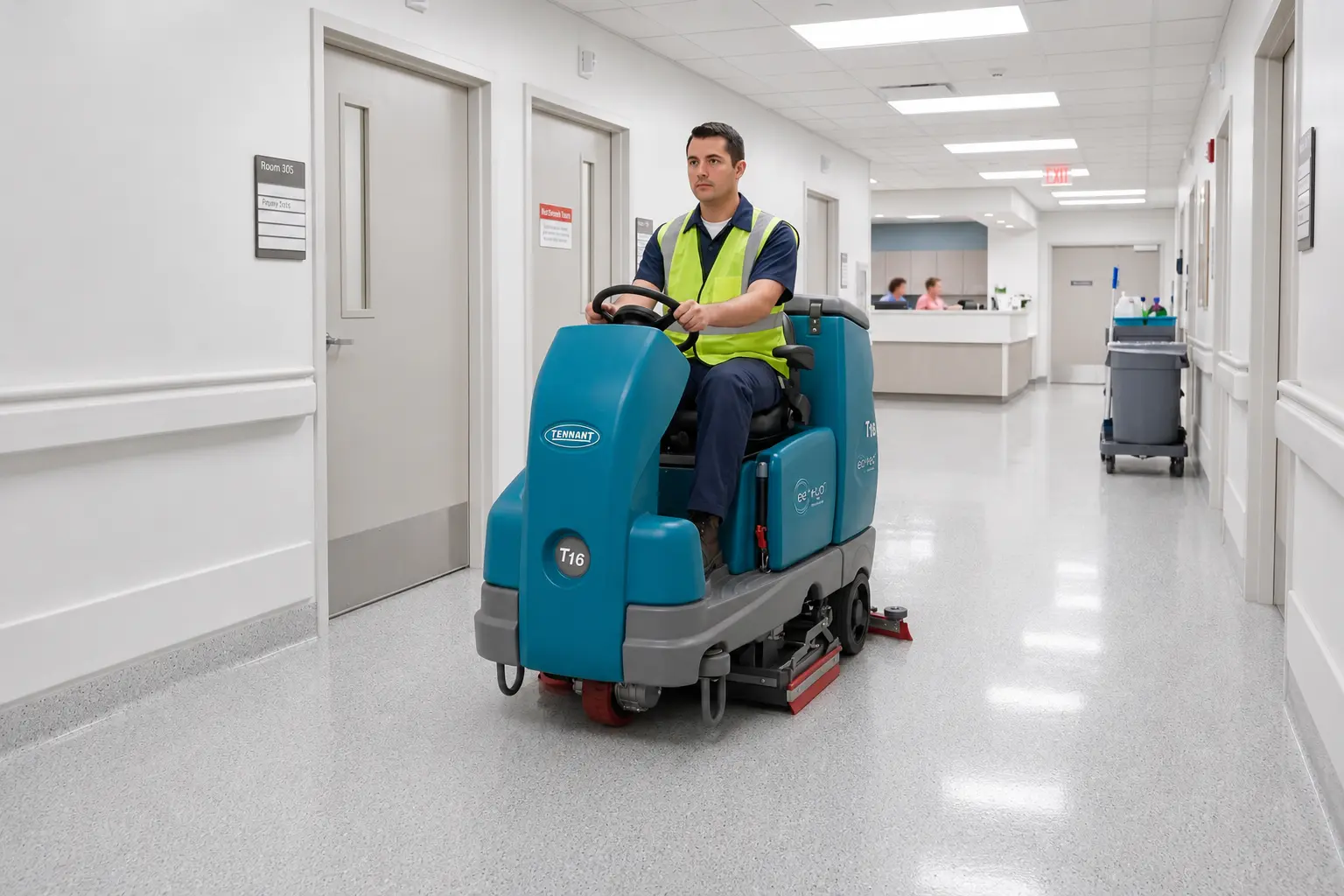
Floor Cleaning and Infection Control in Hospitals
Clean floors are part of a hospital’s infection-control picture, and the equipment matters. The right machine does more than make floors look clean, it limits the moisture and soil that create real risks.
- Consistent cleaning: an automatic scrubber removes soil and moisture the same way on every pass, unlike the uneven coverage of a mop and bucket.
- Controlled dosing: cleaning solution is applied at a controlled rate, not the hit-or-miss coverage of mopping.
- Dirty water recovered: the machine picks up the dirty water rather than pushing it around the floor.
- Fast drying: floors are left nearly dry, cutting the standing moisture where bacteria persist and where slips happen.
- Cleans during operating hours: quiet, low-moisture operation means corridors and common areas can be cleaned without disrupting patients or staff.
Rent or Buy Hospital Floor Cleaning Equipment
Whether to rent or buy comes down to how often you clean and how predictable your needs are. Buying makes sense for daily, year-round cleaning of a fixed footprint. Renting makes sense when you need a machine for a specific stretch: a seasonal peak, a renovation or turnover, a trial before committing to a purchase, or a backup while your own machine is being serviced.
Thompson Flooring Solutions offers floor scrubber rentals and floor sweeper rentals with delivery, setup, and operator guidance, on short-term and long-term terms across the Southeast US. If you are not sure which machine fits, our team will match the right walk-behind, ride-on, or sweeper-scrubber to your floor type, square footage, and cleaning schedule, and handle equipment servicing and support so your machine keeps running.
Not Sure What Kind of Floor Cleaning Equipment You Need?
Every medical facility has a unique layout and different traffic patterns. Our team will work with you to evaluate floor types, square footage, and specific cleaning requirements to recommend the right floor cleaning solutions by industry standards.
Contact us today to talk through your facility’s needs and help select equipment that supports safety and efficiency.
Need floor cleaning equipment for your hospital?
Thompson Flooring Solutions supplies and rents commercial floor scrubbers and sweepers, with servicing and expert advice, for healthcare facilities across the Southeast US.
FAQs About Hospital Floor Cleaning Equipment
What do hospitals use to clean floors?
Hospitals use microfiber flat mops and hospital-grade disinfectant in patient rooms and tight spaces, and automatic floor scrubbers for large hard-floor areas like corridors, lobbies and cafeterias. Thompson Flooring Solutions supplies and rents walk-behind and ride-on floor scrubbers for healthcare facilities across the Southeast US.
What floor scrubber is best for hospitals?
Walk-behind scrubbers suit patient wings and tighter spaces where maneuverability and quiet operation matter, while ride-on scrubbers suit long corridors, lobbies and large open areas where speed and coverage matter. Thompson Flooring Solutions helps match the machine to your facility layout and square footage.
Can hospital floors be cleaned while patients and staff are present?
Yes. Modern scrubbers run quietly and leave floors nearly dry, so corridors and common areas can be cleaned during operating hours with minimal disruption and reduced slip risk. Thompson Flooring Solutions supplies equipment built for active healthcare environments.
What kinds of mops do hospitals use?
Hospitals typically use microfiber flat mops for infection control in patient areas because they trap soil and hold disinfectant well. For large hard floors, automatic scrubbers clean more consistently and with far less labor than mopping, which is why most facilities use both. Thompson Flooring Solutions supplies the scrubbers for the larger areas.
How does floor cleaning equipment support infection control?
Floor scrubbers remove soil and moisture consistently, apply cleaning solution at controlled rates, and recover dirty water rather than spreading it. Fast drying limits the standing moisture that harbors bacteria and causes slips. Thompson Flooring Solutions supplies equipment suited to healthcare cleaning protocols.
What floor cleaning machines work for large hospital campuses?
Large hospital campuses use ride-on scrubbers for corridors, lobbies and atriums, scrubber-sweepers for entrances and loading docks, and walk-behind machines for tighter clinical spaces. Thompson Flooring Solutions supplies and rents all three for healthcare facilities across the Southeast US.
Where can I rent hospital floor cleaning equipment?
Hospital floor cleaning equipment can be rented from commercial suppliers like Thompson Flooring Solutions, which rents walk-behind scrubbers, ride-on scrubbers and scrubber-sweepers for healthcare facilities. Rentals include delivery, setup and operator guidance, on short-term and long-term terms across the Southeast US.
How often should hospital floors be cleaned?
High-traffic hospital areas are usually cleaned daily or several times a day, while lower-traffic spaces follow a set schedule from facility policy. Consistent scrubbing keeps floors safe and supports infection control. Thompson Flooring Solutions supplies equipment that makes frequent cleaning practical.